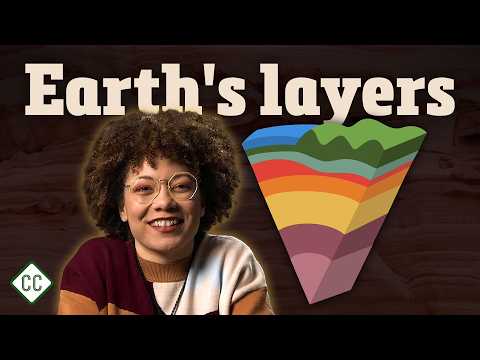
What Are Earth's Crust and Mantle?
Earth's crust is the thin, solid outer layer where we live. It's made of rock and soil. The mantle sits directly beneath it. It's a hot, dense layer of rock that makes up most of Earth's volume. The crust and mantle interact constantly. This interaction drives plate tectonics and shapes our planet. Understanding these layers is essential to geology fundamentals.
The Crust: Earth's Solid Outer Shell
The crust is surprisingly thin. Imagine Earth as an apple. The crust would be thinner than the skin. It ranges from about 5 to 70 kilometers thick depending on location.
There are two types of crust. Oceanic crust covers the ocean floor. It's denser and younger, usually between 5 and 10 kilometers thick. Continental crust underlies continents. It's lighter and older, ranging from 30 to 70 kilometers thick. This difference matters for plate tectonics.
The crust is broken into large pieces called tectonic plates. These plates float on the mantle below. They move slowly, colliding, sliding past each other, or pulling apart. This movement causes earthquakes, volcanoes, and mountain formation.
The crust contains all the rocks and minerals we extract. If you're interested in understanding geological resources in your area, Explore Industries to find local mining or geological service businesses near you.
The Mantle: The Engine of Earth's Dynamics
The mantle extends from the base of the crust down to Earth's outer core. It makes up about 84% of Earth's volume. Despite its enormous size, we know surprisingly little about it directly. We can't drill there. We learn about the mantle through seismic waves from earthquakes and laboratory experiments.
The mantle is composed mainly of silicate rocks rich in iron and magnesium. Common minerals include olivine and pyroxene. The mantle is hot. Temperatures range from 1,000 degrees Celsius at the top to over 3,700 degrees Celsius near the core.
Despite this heat, the mantle is solid, not liquid. The immense pressure from all the rock above keeps it solid. However, the mantle does flow slowly over geological time. This slow movement is crucial for plate tectonics.
The upper portion of the mantle, called the asthenosphere, is slightly softer and flows more easily. This layer allows the rigid tectonic plates above to move. Without this soft layer, plate tectonics wouldn't happen.
How Crust and Mantle Drive Plate Tectonics
The crust and mantle work together as a system. Heat from the mantle drives convection currents. Hot rock rises toward the crust. Cool rock sinks back down. This circulation is like a vast, slow conveyor belt.
At mid-ocean ridges, hot mantle material rises and creates new oceanic crust. Magma flows out and solidifies. This pushes existing plates apart. At subduction zones, cool oceanic plates sink back into the mantle. This destroys crust and recycles material.
This cycle is continuous. The same atoms in your body may have cycled through the mantle millions of times. Understanding this process explains earthquakes, volcanic eruptions, and why mountains exist.
For those interested in geology careers or learning more locally, Find local service pros near you who offer geological surveys, environmental assessments, or educational workshops in your area.
Why This Matters Today
Knowing about the crust and mantle helps us predict natural disasters. It guides resource exploration. It explains climate change connections. Geological processes operate on timescales we struggle to imagine. A mountain that took millions of years to form disappears in geological seconds.
The crust-mantle system is dynamic and powerful. Every earthquake, volcano, and continental shift traces back to these two fundamental layers. Geology isn't just about rocks. It's about understanding the living, changing planet beneath our feet.